

The Future of Data Centers is Submerged: Why the Immersion Cooling Market is Set for Explosive Growth
The digital world runs on data, and data centers are its engine rooms. For decades, we’ve cooled these critical facilities with, essentially, sophisticated air conditioning. But as computational demands skyrocket, traditional air cooling is hitting a physical and financial wall. A transformative solution is not just on the horizon—it’s here, and it’s poised for a massive surge.
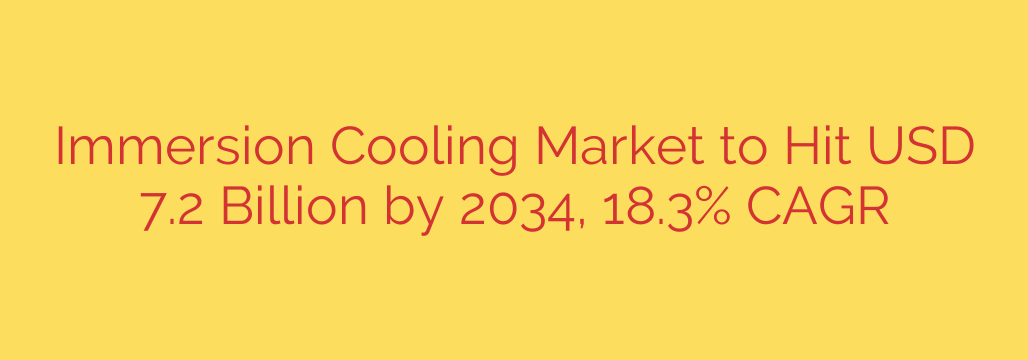
The market for immersion cooling, a technique where IT hardware is submerged in non-conductive dielectric fluid, is on a trajectory of unprecedented expansion. Industry forecasts indicate that the immersion cooling market is projected to reach an astounding USD 7.2 billion by 2034, growing at a compound annual growth rate (CAGR) of over 18%. This isn’t just a trend; it’s a fundamental shift in how we design, build, and operate the digital infrastructure of tomorrow.
So, what’s fueling this incredible growth? It’s a perfect storm of technological necessity, economic pressure, and environmental responsibility.
The Unstoppable Drivers of Liquid Cooling
Several key factors are pushing data centers to abandon air for fluid. Understanding these drivers reveals why immersion cooling is moving from a niche technology to a mainstream necessity.
The Rise of AI and High-Density Computing: Artificial intelligence, machine learning, and high-performance computing (HPC) workloads require immense processing power. This means server racks packed with powerful GPUs and CPUs that generate an incredible amount of heat—often far more than air can efficiently dissipate. Immersion cooling offers up to 1,000 times the heat capacity of air, making it the only viable solution for cooling these next-generation, high-density racks.
The Urgent Need for Energy Efficiency: Data centers are notoriously power-hungry, with cooling systems accounting for up to 40% of their total energy consumption. This is a massive operational expense and an environmental concern. Immersion cooling drastically reduces Power Usage Effectiveness (PUE), a key metric for data center efficiency. By eliminating the need for energy-intensive fans, chillers, and CRAC units, facilities can slash their energy bills and significantly reduce their carbon footprint.
Sustainability as a Corporate Mandate: As environmental, social, and governance (ESG) goals become central to corporate strategy, companies are under intense pressure to operate more sustainably. Immersion cooling allows data centers to not only reduce electricity consumption but also enables heat reuse. The captured heat from the liquid coolant can be repurposed for heating nearby buildings or other industrial processes, turning a waste product into a valuable asset.
Enhanced Hardware Reliability and Longevity: Air cooling exposes sensitive electronics to dust, humidity, vibration from fans, and fluctuating temperatures. Submerging hardware in a clean, stable dielectric fluid eliminates these environmental threats. This controlled environment prevents corrosion and thermal stress, which extends the lifespan of sensitive IT hardware and reduces failure rates, leading to a lower total cost of ownership (TCO).
Understanding the Technology: Single-Phase vs. Two-Phase
Immersion cooling isn’t a one-size-fits-all solution. The market is primarily divided into two main approaches:
Single-Phase Immersion Cooling: In this method, servers are placed in a bath of dielectric fluid. The fluid absorbs the heat and is then circulated to a heat exchanger, where it is cooled before returning to the bath. The fluid remains in a liquid state throughout the entire process. This approach is valued for its relative simplicity and lower cost of implementation.
Two-Phase Immersion Cooling: This more advanced technique uses a fluid with a very low boiling point. As the hardware heats up, the fluid boils and turns into a vapor. This phase change absorbs a massive amount of heat energy. The vapor rises, cools on a condenser coil, and condenses back into a liquid, dripping back into the tank. Two-phase systems are incredibly efficient at heat removal and ideal for the most extreme high-density applications.
Actionable Advice for IT Leaders and Data Center Operators
The projected market growth sends a clear signal: preparing for liquid cooling is no longer optional.
Evaluate Your Current Infrastructure: Assess the limitations of your current air-cooling system. Are you struggling with hotspots? Are energy costs spiraling? Are you unable to deploy the latest high-density hardware? Answering these questions can help build the business case for an immersion cooling pilot project.
Focus on Total Cost of Ownership (TCO): While the initial investment for immersion cooling can be higher than traditional systems, the long-term savings are significant. Factor in reduced energy consumption, lower maintenance costs, extended hardware life, and the potential for increased server density in the same physical footprint.
Plan for the Future: Even if you aren’t deploying AI clusters today, the trend toward more powerful and hotter components is clear. Designing new data center builds or retrofits with immersion cooling in mind will future-proof your facility for the computational demands of the next decade.
In conclusion, the meteoric rise of the immersion cooling market is a direct response to the fundamental challenges facing the digital age. It represents a shift from brute-force air cooling to a more elegant, efficient, and sustainable solution. As data continues to define our world, the facilities that house it will increasingly be submerged in the fluid technology of the future.
Source: https://datacenterpost.com/data-center-immersion-cooling-market-to-reach-usd-7-2-billion-by-2034-growing-at-18-3-cagr/






